Yay!
Patti Smith is writing a sequel!
I'm really looking forward to this.
J

Showing posts with label literature. Show all posts
Showing posts with label literature. Show all posts
Friday, March 25, 2011

Thursday, March 24, 2011
The Diving Bell and the Butterfly
For those of you who are unfamiliar with this harrowing tale, let me break it down for you: a powerful, narcissistic magazine editor named Jean-Dominique Bauby (aka Jean-Do) has a stroke and is paralyzed from head to toe. His mind, however, functions fine, and must continue to live his life as if he were a man trapped in an immobile body. The only part he can move is his one eye - he can blink. Such is the condition called locked-in syndrome. Jean-Do writes his autobiography by working with a speech therapist and blinking while she lists off the letters of alphabet and stops at the one he wishes to use.

The film is spectacular. I love the opening scenes and how the film is shown through Jean-Do's myopic perspective. I also love the scene where they sew up Jean-Do's bad eye while he silently protests to himself but instead of the screen going black, it goes a peachy orange, because such is what happens when you close your eyelids and it is still spectacularly bright outside (I know this because I often go to bed when the sun is out). I just love the overall tone of this film. It has such a delicate realism to it (lots of long shots and scenes without dialogue) and I love the fuzzy cinematography but it's also punctuated by surreal moments of clarity.

I watched this with boyfriend (first for him, second for me) and towards the end, he said, "this movie makes me sad." I don't think I can say it any more succinctly than that. The film is about a man who feels like he's stuck in a diving bell, lost under water, incapable of escape, and the beautiful, free butterfly that is his imagination, which allows him to do whatever he wants and makes him feel more alive than when he was as a moving, talking body.
I also read the book for a paper in my last year in undergrad and the autobiography is just as poignant as the film. But it isn't so much an autobiographical narrative as it is a touching compendium of all of Jean-Do's insightful and ironic observations about the ephemeral past and the even more ephemeral moments of life.
I also didn't know (or didn't fully realize) that it was directed by Julian Schnabel, an artist that I'm a big fan of.
J

Photo courtesy of Entertainment Wallpaper
The film is spectacular. I love the opening scenes and how the film is shown through Jean-Do's myopic perspective. I also love the scene where they sew up Jean-Do's bad eye while he silently protests to himself but instead of the screen going black, it goes a peachy orange, because such is what happens when you close your eyelids and it is still spectacularly bright outside (I know this because I often go to bed when the sun is out). I just love the overall tone of this film. It has such a delicate realism to it (lots of long shots and scenes without dialogue) and I love the fuzzy cinematography but it's also punctuated by surreal moments of clarity.
Photo courtesy of The Revolving Door
I watched this with boyfriend (first for him, second for me) and towards the end, he said, "this movie makes me sad." I don't think I can say it any more succinctly than that. The film is about a man who feels like he's stuck in a diving bell, lost under water, incapable of escape, and the beautiful, free butterfly that is his imagination, which allows him to do whatever he wants and makes him feel more alive than when he was as a moving, talking body.
I also read the book for a paper in my last year in undergrad and the autobiography is just as poignant as the film. But it isn't so much an autobiographical narrative as it is a touching compendium of all of Jean-Do's insightful and ironic observations about the ephemeral past and the even more ephemeral moments of life.
I also didn't know (or didn't fully realize) that it was directed by Julian Schnabel, an artist that I'm a big fan of.
J
Wednesday, February 2, 2011
The Bluest Eye
I finished Toni Morrison's first novel, The Bluest Eye, about a week ago and I haven't gotten around to sharing my thoughts.
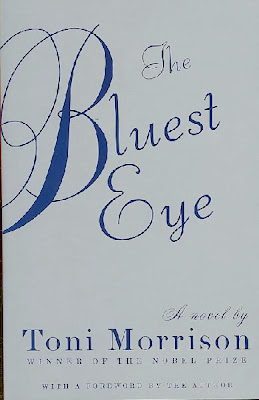 My experience with this novel was a little bit restless. It's about a black girl named Pecola Breedlove who longs for blue eyes so she can be treated better by her family and her small, black Southern community. Although it's a very poignant book about racism (especially racism against one's own ethnicity), sexuality, violence, and family, I was expecting it all to be about Pecola's struggles with her identity. This is what the back of the book advertises but the majority of the novel jumps back and forth between different characters around the town and different characters from the Breedlove's pasts. It's sandwiched by Pecola's experiences (kind of like how Junot Diaz's The Brief Wondrous Life of Oscar Wao is largely about Oscar's family back in Santo Domingo, Dominican Republic and is sandwiched by Oscar's life in the US) and when I reached the end, I realized why Morrison did this.
It's not as organized and as tightly wound as Beloved, Morrison's second novel which also jumps all over the place. There are some truly harrowing moments in The Bluest Eye and one episode in particular that truly caught me off guard. The subject of this portion is a despicable fellow whom nobody is supposed to like but Morrison describes him like any other person with neither a sympathetic nor a censorious tone. And when she explains the reasons for his deviance, I felt like Morrison had done something that a lot of great authors do and that is to make you see and understand something from a completely different perspective. I was surprised and shocked by my ability to exit my solipses and my subjectivity and not many writers are able to do that for me, to really make me think and go, "Wow, I've never thought of it like that before."
I think it's pretty amazing when you can disassociate yourself from yourself. It's like looking into a mirror and realizing that you're not the body but the reflection.
J


It's not as organized and as tightly wound as Beloved, Morrison's second novel which also jumps all over the place. There are some truly harrowing moments in The Bluest Eye and one episode in particular that truly caught me off guard. The subject of this portion is a despicable fellow whom nobody is supposed to like but Morrison describes him like any other person with neither a sympathetic nor a censorious tone. And when she explains the reasons for his deviance, I felt like Morrison had done something that a lot of great authors do and that is to make you see and understand something from a completely different perspective. I was surprised and shocked by my ability to exit my solipses and my subjectivity and not many writers are able to do that for me, to really make me think and go, "Wow, I've never thought of it like that before."
I think it's pretty amazing when you can disassociate yourself from yourself. It's like looking into a mirror and realizing that you're not the body but the reflection.
J
Thursday, January 27, 2011
Sleepless Nights
From January 20, 1011
It's shortly past 5 in the morning and I'm wide awake. Such is my life when my body's circadian rhythm fails to coincide with that of the Earth's rotation around the Sun. I've had the problem my whole life (as far as I can remember) and regardless of how tired I am during the day, even if I've gotten no sleep the previous night, I cannot fall asleep at a normal hour.
I felt like I'd made a petite triumph back in December when I was going to bed around 1 or 2. Although that might be considered late for some, that's early for me, especially since I average around 4 or 5 am. Anyway, I'd discovered a trick to help me reach shuteye status: crossword puzzles. Don't get me wrong, I love crosswords and I adore puzzles and reading a book tends to excite me but something about reading and re-reading obtuse clues from the New York Times just put me to sleep. I was quite happy with this progress but I've relapsed and am blogging in lieu of sleeping. I have one sleeping pill left (and those rarely ever work either) but I want to save it for when I have an actual reason to get up in the morning. I don't have the schedule for my new job yet so sleeping in is still part of my current vocation.
This is all very fitting since the last book I read was Elizabeth Hardwick's Sleepless Nights. I don't have much to say about this book. It's definitely an experimental novel as there's no linear narrative. It's reads like one esoteric New Yorker's diary of her recollections and observations of the world around her. But even diaries have some sense of organization: Dear Diary: this was my day, this is how I felt about it, now this is what I'm going to do. Hardwick is all over the place and her prose is very discursive, very figurative, very cynical. Nothing great, but still a pleasant read.
 I'm looking forward to reading her collection of short stories.
J
It's shortly past 5 in the morning and I'm wide awake. Such is my life when my body's circadian rhythm fails to coincide with that of the Earth's rotation around the Sun. I've had the problem my whole life (as far as I can remember) and regardless of how tired I am during the day, even if I've gotten no sleep the previous night, I cannot fall asleep at a normal hour.
I felt like I'd made a petite triumph back in December when I was going to bed around 1 or 2. Although that might be considered late for some, that's early for me, especially since I average around 4 or 5 am. Anyway, I'd discovered a trick to help me reach shuteye status: crossword puzzles. Don't get me wrong, I love crosswords and I adore puzzles and reading a book tends to excite me but something about reading and re-reading obtuse clues from the New York Times just put me to sleep. I was quite happy with this progress but I've relapsed and am blogging in lieu of sleeping. I have one sleeping pill left (and those rarely ever work either) but I want to save it for when I have an actual reason to get up in the morning. I don't have the schedule for my new job yet so sleeping in is still part of my current vocation.
This is all very fitting since the last book I read was Elizabeth Hardwick's Sleepless Nights. I don't have much to say about this book. It's definitely an experimental novel as there's no linear narrative. It's reads like one esoteric New Yorker's diary of her recollections and observations of the world around her. But even diaries have some sense of organization: Dear Diary: this was my day, this is how I felt about it, now this is what I'm going to do. Hardwick is all over the place and her prose is very discursive, very figurative, very cynical. Nothing great, but still a pleasant read.


J
The Brief Wondrous Life of Oscar Wao
I was really looking forward to this book because I have a lot in common with the protagonist (the author?) I'm not Dominican but I do come from an immigrant family and I was also a ghetto nerd (minus the ghetto). Now, I wasn't nearly as nerdy as your stereotypical fanboy - I didn't play Dungeons and Dragons, I wasn't hugely into comic books or video games, and I still had friends, but Tolkien, Star Wars, and a LOT of books and alone-time helped me stay afloat in suburbia. Like Oscar, I was obsessed with the opposite sex but had no social skills, I hated running and physical exercise, I read vociferously to dull my pain and I wrote fictional stories to escape my reality.
Oscar is my homeboy.

All in all, I enjoyed this book. I love the colloquial voice and the seemingly regressive narrative (it starts with Oscar in the present day and it documents the lives of his family backwards, so after Oscar it's his sister Lola, their mother Beli, and then their grandfather Abelard). It was also extremely funny, but the humour comes at the expense of the Dominican experience under the harsh regime of the dictator, Trujillo. It's got some very heavy subject matter: sexual violence, violence, rape, misogyny, suicide, bullying, etc. but it's all presented in a very light tone but Diaz doesn't do this to diminish the potency of those travesties, but rather, he evokes a tongue-in-cheek prose to illustrate the absurdity of having a voice while you are simultaneously being silenced: the Dominicans by their own government, Lola by her mother, Oscar by the culture and society of steroidal America, and ultimately, of himself. The joking and the lightheartedness gets them all through the mess.
J
Oscar is my homeboy.
All in all, I enjoyed this book. I love the colloquial voice and the seemingly regressive narrative (it starts with Oscar in the present day and it documents the lives of his family backwards, so after Oscar it's his sister Lola, their mother Beli, and then their grandfather Abelard). It was also extremely funny, but the humour comes at the expense of the Dominican experience under the harsh regime of the dictator, Trujillo. It's got some very heavy subject matter: sexual violence, violence, rape, misogyny, suicide, bullying, etc. but it's all presented in a very light tone but Diaz doesn't do this to diminish the potency of those travesties, but rather, he evokes a tongue-in-cheek prose to illustrate the absurdity of having a voice while you are simultaneously being silenced: the Dominicans by their own government, Lola by her mother, Oscar by the culture and society of steroidal America, and ultimately, of himself. The joking and the lightheartedness gets them all through the mess.
J
Friday, January 14, 2011
The Decay of Lying
"Is fortunate for us, however, that nature is so imperfect, as otherwise we should have no art at all. Art is our spirited protest, our gallant attempt to teach nature her proper place. As for the infinite variety of nature, that is pure myth. It is not to be found in nature herself. It resides in the imagination, or fancy, or cultivated blindness of the man who looks at her.
One does not see anything until one sees its beauty. Then, and then only, does it come into existence."
~ Oscar Wilde

J
One does not see anything until one sees its beauty. Then, and then only, does it come into existence."
~ Oscar Wilde


J
Subscribe to:
Posts (Atom)